
WELCOME BONUS 300%
UP TO €2000 + 100
FREE SPINS
UP TO €2000 + 100
FREE SPINS
Home → Blackjack
Blackjack at Lottoland Casino: Variants, Rules and Payouts
Step-by-step Split at the Live Table
Quantum Blackjack Plus Live by Playtech allows wagers between 1 and 5,000 EUR with Quantum Multipliers reaching up to 1,000x on three-card twenty-one combinations. This multiplier structure significantly increases variance compared to standard tables, offering high rollers a chance for massive payouts on specific hand configurations during live sessions.
The game features an RTP of 99.57% when optimal strategy is applied, which differs from Lightning Blackjack by Evolution that caps multipliers at 25x on winning hands. Players can compare these volatility profiles to determine which table best suits their bankroll management strategies while engaging with unlimited seating options available at both venues.
Splitting decisions become critical when managing high stakes, as Infinite Blackjack also offers unlimited seats but includes four side bets like Any Pair and Bust It. High rollers must weigh the potential upside of these side wagers against the base game returns, ensuring their total exposure remains within acceptable limits for the session.
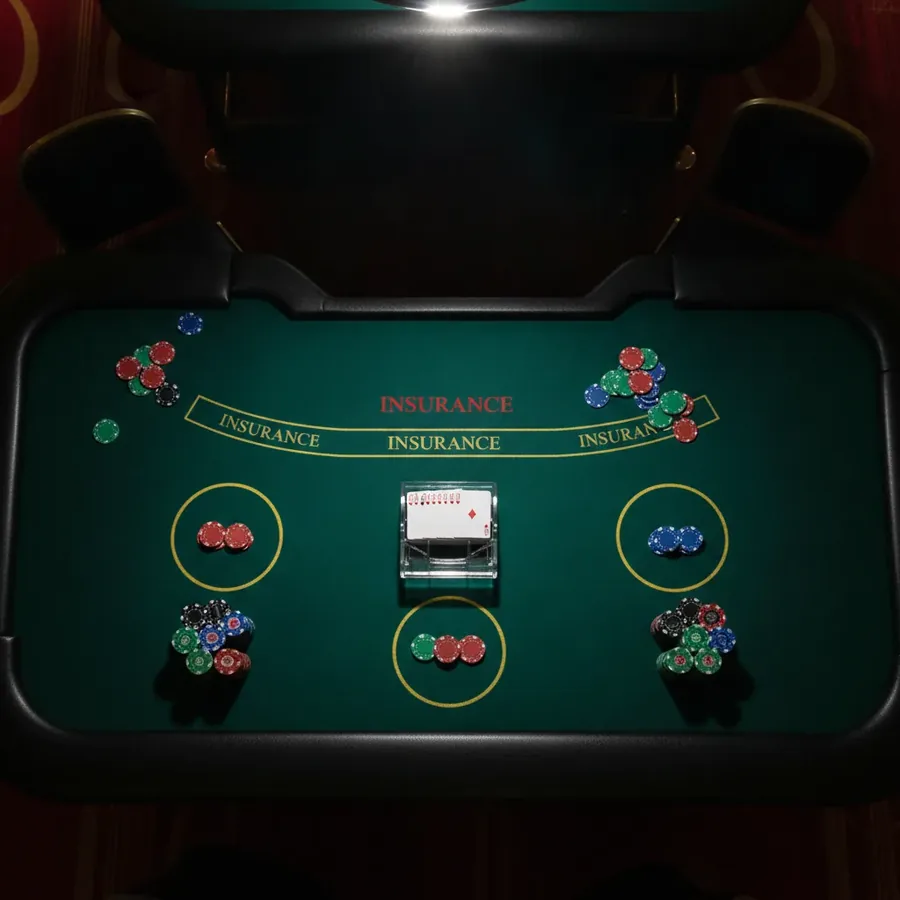
Double Down vs Simple Hit on 11
Blackjack Insurance acts as a separate side bet paying 2:1 when the dealer shows an ace, carrying a house edge of 7.47% and an RTP of only 92.53%. This negative expectation makes insurance statistically unsound for basic strategy players unless they are counting cards with a true count of plus three or higher.
Standard blackjack pays 3:2, yielding 150 EUR on a 100 EUR wager, whereas the 6:5 variant used in some games returns just 120 EUR for the same bet. This difference adds exactly 1.39 percentage points to the house advantage, making the 3:2 payout version mathematically superior for preserving bankroll over extended play periods.
Liberal Vegas Strip rules offer a 0.28% house edge with soft seventeen standing, double after split, and resplit aces allowed, creating a favorable environment for doubling down. In contrast, hitting on soft seventeen increases the house edge by 0.22 percentage points, demonstrating how specific rule variations directly impact long-term profitability for skilled players.
Which rule variants does the software show?
The 6-deck version with soft seventeen standing, double after split, and no surrender rules presents a 0.46% house edge and an RTP of 99.54%. This configuration requires strict adherence to basic strategy to maintain the theoretical return, distinguishing it from single-deck games that typically offer better odds due to fewer cards remaining in the shoe.
Resplitting aces improves the player's position by 0.08 percentage points, while allowing doubles after split enhances it by approximately 0.14 percentage points. These specific modifiers collectively reduce the casino's mathematical advantage, providing high rollers with more flexible opportunities to maximize their expected value during active gameplay sessions.
Late surrender rules allow players to forfeit half their bet after checking for dealer blackjack, improving the RTP by roughly 0.08 percentage points. Early surrender is significantly more valuable, reducing the house edge by up to 0.6 percentage points, though this rare rule variation is seldom found in modern online casino environments.
This surrender mechanic contrasts sharply with the 6:5 payout structure, which independently adds 1.39 percentage points to the house edge regardless of other favorable rules. Understanding these competing influences helps players identify tables where rule benefits outweigh the penalties imposed by reduced payout ratios on natural blackjacks.
How long does a Live Blackjack round take?
Infinite Blackjack by Evolution accommodates unlimited players at the table, allowing high rollers to join queues without waiting for a physical seat to open up. This continuous flow reduces idle time between rounds compared to traditional fixed-seat tables, enabling faster volume of hands processed per hour during peak gaming sessions.
Lightning Blackjack also supports unlimited participants while introducing lightning multipliers up to 25x on winning hands, adding excitement without altering the core speed of play. The betting range spans from 1 to 2,500 EUR, catering to different stake levels while maintaining a consistent pace similar to other live dealer offerings in the portfolio.
Playtech’s Quantum Blackjack Plus operates within a 1 to 5,000 EUR betting window, utilizing quantum multipliers up to 1,000x on three-card twenty-one combinations. The integration of these special features does not significantly delay round completion, ensuring that high-volume players can maintain their desired tempo while chasing large multipliers.
Table games contribute only 10% toward bonus wagering requirements, unlike slots which contribute 100%, meaning high rollers must generate substantial turnover to clear promotional funds efficiently. This restriction impacts the effective speed of bonus conversion, requiring careful calculation of hourly loss rates versus required wagering volumes to avoid unnecessary financial exposure.
How many decks are in the shoe?
Six-deck shoes are standard for many online blackjack variants, introducing approximately 0.02 percentage points more house edge compared to eight-deck games. This slight increase in advantage is often offset by other favorable rules like soft seventeen standing, creating a balanced mathematical environment for strategic decision-making during live dealer sessions.
Single-deck games theoretically offer a lower house edge of 0.15% with an RTP of 99.85%, providing about 0.48 percentage points better odds than eight-deck versions. However, casinos frequently compensate for this advantage by implementing restrictive rules like 6:5 payouts, which negate the benefit of having fewer cards in play.
Insurance bets in six-to-eight deck games carry a steep 7.47% house edge, drastically reducing overall returns for those who choose to place them. High rollers should avoid this side wager entirely unless employing advanced card counting techniques, as the statistical disadvantage remains severe across all deck compositions regardless of other game conditions.
The welcome bonus offers 300% up to 2,000 EUR plus 100 free spins, but table games only contribute 10% toward meeting the wagering requirements. This low contribution rate means that playing blackjack with six decks requires significantly higher turnover to unlock withdrawable funds compared to slot machines, impacting overall bankroll efficiency.
Blackjack variants at a glance
| Variant | Payout | House edge | Rule | Bet range |
|---|---|---|---|---|
| Blackjack Insurance / Versicherung (6–8 Decks) | 92.53% | 7.47% | Separate Nebenwette bis 50% der Hauptwette, wenn der Dealer ein Ass hat. Basisstrategie schreibt IMMER Ablehnung vor (außer Karten zählen bei True Count ≥ +3). Bei einem Deck Vorteil ≈ 5.88% | Insurance 2:1 |
| Blackjack Surrender (Late Surrender) – Regel-Effekt | n.a. (Regel-Modifikator) | −0.08 Prozentpunkte | Spieler gibt Hand nach Dealer-Blackjack-Prüfung auf, verliert die Hälfte des Einsatzes. Verbessert RTP um ca. 0.08 Prozentpunkte. Early Surrender ist wesentlich wertvoller (bis −0.6 Prozentpunkte), aber extrem selten. | Rückzahlung 50% des Einsatzes |
| Blackjack Ein Deck, klassische Regeln, 3:2 | 99.85% | 0.15% | Weniger Decks = niedrigerer Vorteil; ein Deck gibt ca. −0.48 Prozentpunkte gegenüber 8 Decks. Oft durch 6:5 Auszahlung kompensiert. | Blackjack 3:2, Gewinn 1:1 |
| Blackjack Liberal Vegas Strip (liberale Regeln, 3:2) | 99.72% | 0.28% | Günstigste Regelkombination: S17 + DAS + Resplit + Late Surrender. Standardabweichung 1,15 | Blackjack 3:2, Gewinn 1:1 |
| Blackjack Auszahlung 6:5 statt 3:2 (6 Decks) | 98.15% | 1.85% | Ersatz von 3:2 durch 6:5 fügt exakt +1.39 Prozentpunkte zum Vorteil des Casinos hinzu – stärker als jede andere Regeländerung. Bei $10 Einsatz zahlt Blackjack $12 statt $15. | Blackjack 6:5, Gewinn 1:1 |
| Blackjack 6 Decks, S17, DAS, DOA, Auszahlung 3:2, Basisstrategie | 99.54% | 0.46% | Dealer steht auf Soft 17; Verdopplung auf jeder Zweierkarte; Verdopplung nach Split erlaubt; keine Aufgabe. Basisstrategie ist für diesen Wert zwingend | Blackjack 3:2, normaler Gewinn 1:1, Insurance 2:1 |
Soft Hand and Hard Hand Practically Distinguished
Blackjack Liberal Vegas Strip offers a theoretical return of 99.72% against a house edge of 0.28%, representing the most favorable rule combination available to high rollers seeking maximum value. This variant requires the dealer to stand on soft 17, allows doubling after splitting, and includes late surrender, which collectively optimize the player's long-term expectancy compared to restrictive tables. The standard deviation of 1.15 indicates moderate variance, ensuring that bankroll fluctuations remain manageable during extended sessions with substantial stakes.
In contrast, the standard 6-deck version with S17, DAS, and DOA yields a lower RTP of 99.54% and a higher house edge of 0.46%, demanding strict adherence to basic strategy to maintain efficiency. While the absence of surrender rules slightly reduces player flexibility, the ability to double on any two cards and resplit aces provides sufficient strategic depth for advanced play. Players must distinguish these rule sets carefully, as the 0.18 percentage point difference in house edge directly impacts the expected loss rate over thousands of hands.
Quantum Blackjack Plus Live from Playtech introduces quantum multipliers up to 1,000x on three-card combinations totaling 21 points, allowing bets between 1 and 5,000 EUR to achieve significant payouts. This live dealer game maintains an RTP of 99.57% when optimal strategy is applied, blending traditional soft hand management with high-volatility bonus features. High rollers can leverage these multipliers to amplify wins on strong hands, though the presence of side bets may alter the overall risk profile if not managed correctly.
Bonus conditions often exclude Blackjack completely
The 300% welcome bonus up to €2,000 plus 100 free spins comes with specific contribution rates that significantly limit its utility for table game players. Blackjack games contribute only 10% toward the wagering requirement, meaning that every €100 wagered counts as just €10 toward the turnover target. This low contribution rate forces players to bet ten times more volume on blackjack than they would on slots to clear the bonus effectively.
For instance, clearing a €2,000 bonus with a standard 40x wagering requirement demands €80,000 in total turnover. If played entirely on blackjack, this equates to €800,000 in actual wagers due to the 10% contribution factor, exposing the bankroll to excessive house edge accumulation. Such terms make the bonus economically unviable for serious blackjack players who rely on precise strategy to minimize losses.
High rollers typically find such restrictions prohibitive, as the time and capital required to meet the turnover targets far exceed the potential value of the matched funds. Alternative bonuses with higher table game contributions or dedicated VIP rewards offer better alignment with professional playing styles. Without transparent terms, the incentive structure inherently favors slot enthusiasts over skilled card players seeking consistent returns.
16 vs 10 played incorrectly: most common error
Basic strategy dictates specific actions for hard 16 against a dealer’s 10, yet deviations here cost players approximately 0.22 percentage points in RTP when the dealer hits soft 17. Incorrectly standing or hitting in this scenario increases the house edge, eroding the advantage gained from liberal rules like doubling after split. Precision in these marginal decisions separates profitable long-term play from gradual bankroll depletion.
Insurance bets present another frequent error zone, offering a payout of 2:1 but carrying a steep house edge of 7.47% when taken without counting cards. The RTP for insurance stands at 92.53%, making it one of the worst bets in the casino unless the true count reaches +3 or higher. Taking insurance on a random basis drains funds rapidly, especially for high-stakes players placing large primary wagers.
Late surrender improves the base RTP by 0.08 percentage points by allowing players to forfeit half their stake when facing unfavorable odds. This option is particularly valuable when holding a hard 16 against a dealer 10, reducing expected losses compared to playing out the hand. Utilizing surrender strategically preserves capital, whereas ignoring it exposes players to unnecessary variance and higher cumulative deficits.
Bonus Lost Due to 10 Percent Contribution
With blackjack contributing only 10% to bonus turnover, high rollers face a mathematical disadvantage that negates the perceived value of the 300% match up to €2,000. A €1,000 bonus requires €40,000 in eligible turnover, translating to €400,000 in actual wagers at the table if played exclusively on blackjack games. This volume amplifies exposure to the house edge, often resulting in net losses that exceed the bonus amount itself.
Comparing this to slots, which contribute 100%, reveals a stark inefficiency in using matched funds for card games. Players relying on blackjack strategy to manage risk cannot leverage the bonus effectively, as the slow progress toward clearance increases the probability of violating other terms. The structural design prioritizes slot engagement, leaving table game specialists with minimal benefit from promotional offers.
Even with optimized play, the combination of low contribution rates and inherent house edges makes bonus retention unlikely for dedicated blackjack players. Those seeking genuine value should evaluate whether the time invested in meeting wagering requirements justifies the limited financial upside. Many high rollers opt to decline such bonuses, preferring to protect their bankroll from the compounding effects of restricted gameplay.
RNG draws cards from virtual eight-deck shoe
Standard RNG blackjack variants utilize virtual shoes containing six or eight decks, influencing the house edge through card composition and shuffling frequency. Using six decks instead of eight reduces the house edge by approximately 0.02 percentage points, a minor but measurable improvement for precision players. This adjustment highlights how subtle rule variations impact long-term expectations across different software implementations.
Live dealer tables like Infinite Blackjack offer unlimited seats and four side bets, including Any Pair, 21+3, Hot 3, and Bust It, with bets ranging from 1 to 5,000 EUR. These games operate with physical cards shuffled electronically, maintaining an RTP of 99.47% under optimal conditions. The transparency of live dealing appeals to high rollers who prefer verifiable randomness over algorithmic generation.
Lightning Blackjack from Evolution adds lightning multipliers up to 25x on winning hands, creating opportunities for significant payouts within a single round. Bets range from 1 to 2,500 EUR, and the game supports unlimited players while delivering an RTP of 99.56%. High rollers can capitalize on these multipliers to enhance returns, provided they balance risk with disciplined bankroll management across multiple sessions.
Double Down after Split: which tables allow it
The Quantum Blackjack Plus Live table by Playtech allows doubling after split, offering a significant edge for high rollers who wish to maximize their exposure on strong hands. This liberal rule reduces the house edge by approximately 0.14 percentage points compared to stricter variants that prohibit this maneuver during play.
Infinite Blackjack by Evolution also permits doubling after splitting, providing unlimited seats and side bets while maintaining an RTP of 99.47 percent. Players can double down on any two cards, including those received after a split, which enhances strategic flexibility at stakes up to 5,000 EUR.
Conversely, Lightning Blackjack by Evolution restricts doubling only to the initial two cards, disallowing doubling after a split entirely. This limitation increases the house advantage slightly, yet the table remains attractive with multipliers up to 25x and betting limits reaching 2,500 EUR for high-stakes participants.
Even Money only possible with Dealer Ace
Insurance bets in Blackjack are triggered exclusively when the dealer shows an Ace, allowing players to secure even money on their hand if the dealer has a natural blackjack. This side bet pays out at 2:1 but carries a substantial house edge of 7.47 percent, making it mathematically unfavorable for most strategies.
The RTP for insurance wagers drops significantly to 92.53 percent due to the high house edge, which erodes long-term returns for players who frequently take this option. Basic strategy dictates always rejecting insurance unless counting cards reveals a true count of plus three or higher in six-deck games.
For single-deck games, the house edge on insurance is lower at approximately 5.88 percent, yet still negative for standard players without card counting skills. High rollers should avoid this bet to preserve their bankroll, as the expected value loss outweighs the psychological comfort of guaranteed payouts.
Latency under 2 seconds at the live table
Quantum Blackjack Plus Live by Playtech features quantum multipliers up to 1,000x on three-card combinations totaling twenty-one points, enhancing excitement for high stakes. The game maintains an RTP of 99.57 percent with optimal strategy, appealing to players seeking both speed and massive win potential at bets ranging from one to five thousand euros.
Infinite Blackjack by Evolution offers unlimited seating at the virtual table, ensuring no waiting time between hands for active players. With betting limits up to five thousand euros and side bets like Any Pair and Bust It, this variant caters to high rollers who demand immediate action and diverse wagering options.
Lightning Blackjack by Evolution introduces lightning multipliers up to twenty-five times on winning hands, adding volatility to the classic game structure. Players can wager between one and two thousand five hundred euros, benefiting from fast-paced gameplay that minimizes latency and maximizes engagement for those pursuing large payouts.
Ignored Basic Strategy Chart: 1 Percent Wasted
Deviating from basic strategy in Blackjack Ein Deck increases the house edge from a low 0.15 percent to significantly higher levels, wasting potential winnings. Each decision made against the optimal chart adds roughly one percent to the casino's advantage, drastically reducing the return over hundreds of thousands of hands played.
Playing Blackjack with six decks and 6:5 payouts results in a house edge of 1.85 percent, which is nearly twelve times worse than the 3:2 variant. Ignoring strategy here compounds the disadvantage, as correct play cannot overcome the inherent structural flaw of the reduced payout ratio on blackjacks.
The Liberal Vegas Strip rules offer an RTP of 99.72 percent with a house edge of just 0.28 percent, provided players adhere strictly to basic strategy charts. Deviations erase this slim advantage quickly, turning a favorable game into a losing proposition where every mistake costs money in the long run.
Splitting tens costs expected value: better stand
Splitting tens in Blackjack is a common error that reduces expected value because a total of twenty is a very strong hand likely to win against most dealer upcards. Keeping tens together preserves a high probability of victory, whereas splitting creates two weaker hands starting with ten, increasing the risk of busting or losing both.
Blackjack Surrender allows players to forfeit half their bet after the dealer checks for blackjack, improving the RTP by about 0.08 percentage points. This rule mitigates losses on marginal hands, offering a safer alternative to splitting weak totals or standing on risky ones like sixteen against a nine.
Resplitting Aces improves the RTP by 0.08 percentage points, while doubling after split adds another 0.14 percentage points to player favorability. These specific rules enhance the overall game value, encouraging high rollers to seek tables that permit these actions rather than restricting them.
Contact
Live - online chat
Banking









Providers












Lottoland Casino 2026